When compared to other parts of Portugal we are so lucky to be here on the Silver Coast. There is a wealth of history at hand and some beautiful areas to visit. We list some of these here:
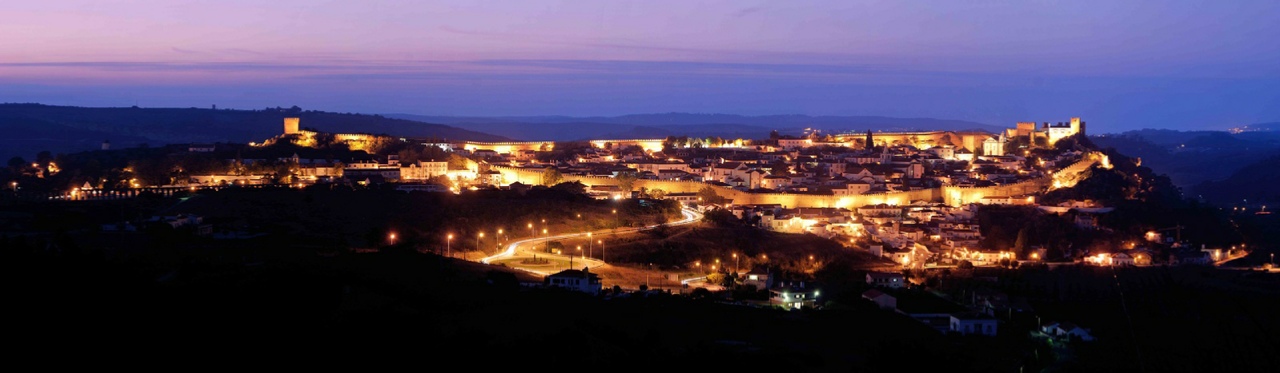
Óbidos – can truly be described as the jewel in the crown.
Óbidos is a medieval walled town which enjoys a magnificent present-day appearance repair as a result of its status as the traditional gift from Portuguese kings to their wives. The monarchy was overthrown only in 1910 and Óbidos reflects the benefits of its patronage until that relatively recent time. Within the walls are fascinating alleys which have become home to high-class handicraft and gift shops as well as bars and restaurants of repute. The town is a very popular stopping-off point for tourist buses from Lisbon so it might be a good idea to take advantage of being on the doorstep and make your visit in the early evening when the crowds have gone and you can enjoy the atmosphere at leisure.
Lisbon – the largest village of them all.
If you are visiting Lisbon we would suggest that you leave your car at the airport and get a cab into town. Cabs are plentiful and cheap and if you get one up to the highest point in the city at the Castelo São Jorge you can save yourself a wearying climb! Remember – it is always hotter in Lisbon. The views from the Castelo over the Tagus estuary and the city are spectacular. Although Lisbon has become a major cosmopolitan destination it still retains some of the atmosphere of a village. It is very much a lived-in city and each bairro or district has its own identity. As you meander down from the castle you will come to the Alfama district with its narrow shopping alleys and shady corners. If you are looking for one of the most happening scenes in Europe for nightlife head for the Bairro Alto which is transformed at dusk into a pulsating area of chic restaurants and lively bars and clubs. A more contemplative time can be spent at the wonderful Oceanarium which is located in the Expo98 site on the banks of the Tagus. Excellent shopping under one roof is available at the vast Colombo Shopping Centre at Benfica. Your guide book will give you a much more comprehensive idea of what Lisbon has to offer.
Foz do Arelho – stunning views and a tranquil lagoon.
Situated at the mouth of the north side of the Óbidos lagoon, Foz do Arelho has long been a much-loved destination for the jaded Lisbon city-dweller. Leading inland from the enormous wave-pounded beach is the tranquil lagoon which in days gone by stretched as far as the fortified town. Now it is the place of work of many ‘clammers’ who extract the delicious local clams which can be found in the restaurants within the town. The beach-side bars offer views over the Atlantic and the lagoon and offer first-class service. Try the Sétima Vaga if you can get a table and enjoy the esoteric selection of music on offer! A wonderful place to watch the sunset.
Caldas da Rainha – thermal spa and your local market town.
Caldas da Rainha means “the queen’s baths” and was christened thus when Queen Dona Leonora came across locals bathing in the mud at the side of the road so as to cure their ailments. She became convinced of the therapeutic qualities of the local waters and founded what is now the oldest thermal hospital in the world. This still functions today when the plumbing is not playing up. Caldas is also renowned nationally for its locally-produced cakes and pastries – try the Pastelaria Machado opposite the entrance to the park if you have a sweet tooth. The daily flower and produce market really should not be missed as this is a fascinating and colourful insight into a way of life which is dying out. Much of the produce is grown locally and could not be fresher, being sold by the very people who have planted and tended it. Otherwise Caldas is a good base for shopping and for necessities such as banks, post office, pharmacies etc. The park has a boating lake and a children’s playground and a café where you can sit under the shade of the trees and watch the world go by.
Alcobaça and Batalha – fascinating history and architecture
The magnificent and austere Cistercian Abbey at Alcobaça dominates the centre of the town. The austere aspect is continued within the church in which are the tombs of King Pedro 1 and Ines de Castro, his murdered mistress. Beyond the church lies the peace and quiet of the “Cloister of Silence”. In contrast, within the Abbey is the massive kitchen with a running stream specially diverted to pass through as a supply of fresh water. The open area of the kitchen chimney is large enough to take a whole ox for roasting. The surround to the sacristy doorway is an outstanding example of Manueline decoration. In 1794, Lord Beckford visited the Abbey and commented that he found some 300 monks “living in a very splendid manner”!
Batalha, by comparison offers an example of the baroque and elaborate Manueline architecture which is the Abbey of Santa Maria da Vitória and which is now a UNESCO world-heritage site. Begun in 1388, and later added to and enhanced by various Portuguese Kings over the next two centuries, the cathedral is an outstanding example of combined Gothic and Manueline architecture. Under its naves rest some of Portugal’s most historic personalities during that period. Here you will find resting the tombs of João I, his English wife Philippa of Lancaster, and their famous offspring, Prince Henry the Navigator whose efforts and determination helped to explore the then unknown world. In the Chapter house lie two unknown soldiers from World War I thus giving the Abbey a military relationship to the 20th century.
Peniche – bracing air and freshly cooked fish.
Peniche is Portugal’s largest fishing port and the industry dominates the town. It is great to take a walk along the sea wall before repairing to one of the many harbour-side restaurants for fresh fish cooked on a barbecue at the roadside. You won’t believe the price either. The fort at Peniche became a prison during the extremes of the dictator Salazar and contains many graphic reminders of the difficulties experienced by many Portuguese prior to the famous bloodless revolution of 1974.
Nazaré - is in the process of change - from one-time traditional and quaint fishing port - to booming Atlantic resort.
The sweeping sandy beach is packed with holiday-makers in brightly coloured rented tents but it's still possible to see local women wearing the traditional seven-layered and short skirts whilst bearing immense loads on their heads and the town's fishermen sporting woollen shirts and bobble hats. Nazaré also has its fair share of tacky souvenir shops and trinket stalls.
The main promenade Avenida da República is lined with some excellent seafood restaurants and bars as well as some less salubrious ones – choose with care.
Fátima - second only to Lourdes as Europe's major pilgrimage centre.
Fátima welcomes millions of devotees a year who come to pray at the site of a miraculous apparition of the Virgin Mary here in 1917.
Three shepherd children had a vision of Mary, who reportedly reappeared on the 13th of each of six subsequent months calling for peace in the world.
On the day of the final apparition a crowd of over 70,000 people had gathered and claimed to witness the Miracle of the Sun, when illnesses and disabilities were cured amongst the onlookers and the sun appeared to shake and tremble in the sky.
A vast white Basilica and esplanade were completed in 1953 as a shrine for the ever growing numbers of pilgrims flocking to the town. To this day pilgrims undertake a circuit of the shrine on their knees as penance or atonement and in supplication for God’s blessing.
Fátima remains a strange mix of devotion and commercialism with many tourist shops selling a mind-boggling array of very tacky religious souvenirs.
Évora – beautiful and historic walled university town.
The historic centre of Évora is also a UNESCO world-heritage site. Situated 130 kms from Lisbon in the Alentejo district, Évora was settled by the Romans who knew it as Liberalitas Julia. There can still be seen the remains of the Temple of Diana, the only Roman architecture of its type remaining in Portugal and which, down the centuries, has been used variously as a brothel and a slaughterhouse after the Romans had moved on. In the middle-ages Évora was one of the more prosperous regions of the country and the vestiges of its wealth can be seen in the numerous monuments that can be visited. One of the more bizarre sights is the 15th century Capela de Ossos or Chapel of Bones which is lined with the remains of the monks who previously lived and worked there. There are a number of very good restaurants in Évora which make a suitable retreat when the Alentejan heat becomes too fierce.
Sintra - Portuguese fairy tale.
With its rippling mountains, dewy forests thick with ferns and lichen, exotic gardens and glittering palaces, Sintra is like a page torn from a fairy tale. Its UNESCO World Heritage–listed centre, Sintra-Vila, is dotted with pastel-hued manors folded into luxuriant hills that roll down to the blue Atlantic. Celts worshipped their moon god here, the Moors built a precipitous castle, and 18th century Portuguese royals swanned around its dreamy gardens. Even Lord Byron waxed lyrical about Sintra’s charms: ‘Lo! Cintra’s glorious Eden intervenes, in variegated maze of mount and glen’, which inspired his epic poem Childe Harold’s Pilgrimage. It’s the must-do day trip and, if time’s not an issue, has enough allure to keep you there for several days. Sintra has become quite popular in recent years, and it's hard to escape the tourist masses (especially in the summer). Go early in the day mid-week to escape the worst of the crowds.
Tomar – city of the Templars.
Tomar is a beautiful city steeped in the fascinating history of the Templar movement. The town, 33 kms from Fátima, was gifted to the Templar movement in 1159 and formed the headquarters of the movement until its dissolution in 1314 when its successor the Order of Christ was relocated to the south of the country to protect the Algarvian coast. The impressive Covento do Cristo dominates the town and speaks volumes to this day of the power of the Templar movement. The highlight of the convent is the ornamentation of the windows on the main facade of its Chapter House , where maritime motifs form a memorial to the sailors who established the Portuguese empire. Later João III (1521-57) transformed the convent into a thoroughgoing monastic community, adding dormitories, kitchens and no fewer than four cloisters. The adjoining two-tiered Great Cloisters comprise one of the purest examples of the Renaissance style in Portugal. Tomar is known also as the spiritual home of the country’s crypto-Jews who secretively continued to follow Judaism in the face of hostility and persecution following upon the Inquisition after its inception in Portugal in 1497. Jews were ordered to convert to Catholicism or be burned at the stake. Many Jews fled to the north of the country. Built on a simple grid plan, Tomar's old quarters preserve all their traditional charm, with whitewashed, terraced cottages lining narrow cobbled streets.
FOZ DO ARELHO
A resort greatly favoured by the Portuguese. There is safe bathing in the lagoon and crashing waves on the other side of the beach where surfing is quite popular. Swimming in the sea can be very dangerous - please be advised by the lifeguards. There are showers and toilets as well as cafes, stalls, and a huge, sandy beach perfect for children. During the summer months there are pedaloes and canoes for hire.
PRAIA D’ EL REY
The beach is huge and can be accessed from a number of points along the cliffs if you are athletic. However if you are slightly less athletic or you have children, it is best to drive to the northern most point of the resort and park in the car park. It is then an easy walk onto the beach. (see Point 18 on the Resort map) Alternatively you can access the beach from the Marriott Hotel. The beach is only supervised in the summer months.
BOM SUCESSO
On the south shore of the Óbidos lagoon five minutes drive from the Praia d’el Rey resort. There is safe bathing in the lagoon but remember that it is tidal and to keep away from the mouth of the lagoon. There are cafés and restaurants and a fine view of Foz do Arelho opposite.
SÃO BERNARDINO
To the south of Peniche this is a lovely sandy beach with tents for hire. It is a manned beach and has a car-park for off-road parking. There is a café but no restaurant.
BERLENGAS
If you are a good sailor why not take the ferry from the quay at Peniche and spend most of a day on the Berlengas, the islands which you can see from the shore. The ferry runs from May until September. Check at the booking office on the quayside for departure times. The waters around the Berlengas are significantly cooler than off the mainland beaches but they are crystal clear and great for scuba-diving.
SÃO MARTINHO DO PORTO
A spectacular shell-shaped bay which is almost closed to the sea ensures safe bathing even for toddlers for much of the year. There is a palm-lined promenade with shops and cafes. There are showers and toilets on the beach. During the summer months pedaloes and canoes can be hired and there is often water-ski instruction. More of an international resort than Foz.
PRAIA SALGADA
Off the road between São Martinho and Nazaré, (follow the sign in the village of Famalicão, this is a huge beach several miles long. There are facilities and bars near the car-park and umbrellas can be hired. if you wish to walk for ten or fifteen minutes you can be completely alone. Nude sunbathing is not unusual. The sea can be incredibly fierce, so don’t count on a swim.
BALEAL
Two superb beaches - situated just north of Peniche. The beaches are either side of a causeway to the village of Baleal and is vast. It is rare that it is not possible to swim here but do be guided by the life-guards and the flags. The water here seems exceptionally clear and the beach shelves gently into the sea so normally safe for little ones or non-swimmers. There are cafes, showers and toilets on the beach. A popular resort with many nationalities.
NAZARÉ
A busy resort with a huge promenade and beach. Very busy at the height of the season. About forty minutes drive from Foz do Arelho and fifty from Praia d’el Rey.
VALE FURADO
To the north of Nazaré and sign-posted off the road to São Pedro de Moel. A beautiful part of the endless beach that forms this part of the coastline. No facilities on the beach so take your own shade and water. Access to the beach is by a steep path. The natural scenery is beautiful and this beach is rarely busy even in August. No lifeguards.
SÃO PEDRO DE MOEL
About an hours drive from Foz do Arelho and situated north of Nazaré this is a more ‘select’ resort and boasts a large sea-front swimming pool which is open in the summer. A lovely beach with interesting rock formations. There are a number of bars and restaurants in the town. The drive to São Pedro is very scenic, through pine forests with occasional glimpses of the sparkling Atlantic. Take a few moments to stop at Sítio on the way to admire the view from Portugal’s highest cliffs.

 Contact Us


